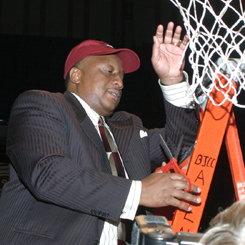
This article originally appeared
in Basketball Times.
A SPECIAL SEASON
What doesn’t kill you will make
you stronger. The Alabama A&M men’s basketball team
experienced this first hand, this past season. It was a
season that would eventually end in the schools’
first-ever division I NCAA tournament appearance --
Something that seemed highly improbable just a few
months earlier.
Led by the junior duo of Joe Martin, Obie Trotter and
some talented freshmen, the Bulldogs figured to compete
for the 2005 SWAC title. Talent wasn’t the issue. Who
would coach the team was.
In late July of 2004, head coach Vann Pettaway was
diagnosed with Prostate cancer. But with surgery
scheduled for September, it appeared that Pettaway would
have time to recuperate before the first tip. That
didn’t happen.
“The surgery was not successful,” says Pettaway. “I
thought I would have the surgery and then return to
coaching, but it didn’t happen that way.”
Ironically, Pettaway felt his team had a chance to do
special things in 2004-05, if they could only stay
healthy.
Competing for the SWAC championship was a difficult task
to begin with, but with questions surrounding the health
of the head coach, the challenge was simply to stay
together as a team.
“It made us stronger as a group,” says Pettaway. “My
role was going to be different because I couldn’t do
nearly as much. It was something that the players, the
staff and the administration fully supported.”
Essentially, Pettaway became an administrative
assistant. Assistant coaches Willie Hayes and Sammy
Jackson became dual head coaches. Pettaway was relegated
to an onlooker, often unable to attend practice and
sometimes barley able to get through a half of
basketball, bordering on dehydration.
It wasn’t the most ideal of situations, but it was
working.
“My goal was to see the season through,” Pettaway says.
“I knew that it was going to be difficult at times, but
I knew, as a group, we could see it through.”
Pettaway’s team was picked to finish fourth, as voted on
by the league’s coaches and sports information
directors. A&M closed out the non-league schedule with a
100-69 loss at UAB. They entered conference play with a
3-7 mark, but Pettaway liked what he saw through those
first ten contests.
“I thought we played much better than our record and the
results indicated,” he said. “With three-minutes
remaining at Georgia we were right there. And we played
Texas A&M right down to the wire. I liked where we were
heading into conference play.”
Pettaway was right. The Bulldogs won 8-of-10 and seized
control of the conference race. On the court they were
winning, but off the court Pettaway continued to
struggle. It was becoming increasingly more difficult
for him to attend practice and just getting through a
game was a challenge. Pettaway evened joked that his
routine to get through a game did not include a
contingency for overtime.
Somewhere during this stretch, Pettaway began to ask
questions. Not of his team, but of his own future.
“I ran through the full spectrum of emotions,” said
Pettaway. “First I asked ‘why me’ and then I began to
feel sorry for myself.”
It got to the point where Pettaway was often rarely even
seen during the week. Hayes and Jackson, who Pettaway
refers to as “saviors,” continued to guide the team in
his absence. But on Feb. 28, with Pettaway on the
sidelines, Alabama A&M did something they had never done
before -- They won the SWAC.
The Bulldogs were a dominant division II force in the
decade of the 1990’s. Pettaway took his teams to eight
NCAA tournaments, four times advancing to the elite
eight. The Bulldogs joined the Southwestern Athletic
Conference in the 1998-99 season and were eligible for
championship status entering the 1999-00 season. Six
seasons later, a 71-53 win over Prairie View clinched
their first division I title.
“It was an unbelievable feeling,” says Pettaway. “The
team had been through so much, but they came together
and won a championship. They became a very tight-knit
group and a special team.”
A&M followed up their regular season title with a
first-ever SWAC tournament championship and a trip to
the NCAA tournament. The Bulldogs were defeated in the
“opening round” contest against Oakland. Having just
completed their run in the SWAC, the Oakland game was
the fourth in six days. But Pettaway was making no
excuses.
“We had a special season,” Pettaway says. “It was very
rewarding for everyone, not just me. My cancer messed
with the entire team, but nobody let it get them down.
They came together and made history. They are the first
team in school history to win a SWAC regular season
title and participate in the NCAA tournament. It was a
pretty good season.”
Currently Pettaway is doing much better and is looking
forward to a season of full duties. With both Trotter
and Martin returning, A&M is thinking about a repeat.
But a second championship and even a win in the NCAA
tournament couldn’t supersede what happened during the
2004-05 season.
Stories from the SWAC usually stay in the SWAC because
the league is not viewed as being significant in the
eyes of many. It’s a shame because Pettaway’s story and
that of the Alabama A&M Bulldogs was fun to follow.
|