HISTORY AND HERITAGE
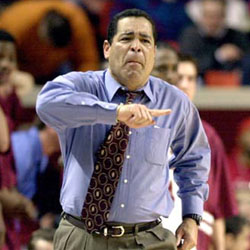
He's a throwback to another era.
It's an expression that is often used, when describing
elder statesman in the world of coaching, but perhaps it
is most fitting for the 47-year old coach at the
University of Oklahoma.
Kelvin Sampson wouldn't mind taking a seat in H.G.
Wells' Time Machine, setting the dial for a return to
the mid 1800's, an era when the Colt revolver was the
motivational pre-game speech.
"Coaching is about strategizing, motivating, cajoling,
pulling and pushing," says Sampson. "That's what the old
west was all about. Back then your game plan was to
prevent cattle rustlers from stealing your herd or
getting your crops to town. In order to survive you had
to be able to thrive on trouble and adversity. That's
coaching."
The images of the old west are tired, coarse, anguish,
frustration and relenting, much like the images on the
sidelines all across America today. It is fitting that
during this hardened period of American history that
John Naismith and Margaret Young gave birth to their
second child, James, in 1861.
While they would eventually breathe the same air,
Sampson points out that, 32 years prior to Naismith's
birth, another legend was born that would have made a
tremendous coach.
"Geronimo would have been a great coach," says Sampson.
"He was the ultimate motivator. Not only was the land of
his people taken, but he had to live life on the run.
Think about how strategic he had to be out maneuver and
outfox the opposition. From a coaching standpoint, we
always try to do more with less and Geronimo was the
epitome of that. Geronimo versus the United States
Calvary was the equivalent to Northern Tech State versus
Duke."
Sampson's passion for the era is as deep as the
Pinkerton's commitment to bringing the outlaws of the
day to justice.
Through the years, Sampson has found time to visit many
of the Civil War battlefields and studied much about the
life and times of President Abraham Lincoln.
"I have always been fascinated with the Civil War and
Lincoln," says Sampson. "He was the greatest president
in American history because of what he fought for. He
stood up for what was right in the wake of adversity and
paid with his life for what he believed in."
Sampson's journey through history has also taken him
through Idaho, South Dakota and Montana, walking on the
hallowed grounds of Little Big Horn and tracing the path
of Chief Joseph's migration to Canada.
"It is something to walk across the same dirt where
Sitting Bull, Chief Joseph and others stood," Sampson
says. "These were some of the ultimate leaders. They had
to deal with the elements, the attitudes of their
warriors and the constant struggle for victory, in the
form of freedom."
Sampson points out that the great leaders like Chief
Joseph, Geronimo and Sitting Bull are not unlike the
leaders with their bands of hardwood warriors today.
"We pride ourselves on dealing with adversity," he says.
"We make our money the day after a home loss or
following a game that we felt we should have won.
Addressing the team in that next practice and getting
them to respond is what drives us."
Sampson, who was a Political Science major in college,
has found many parallels in those who led their teams
into battle over a century ago. But for him it is more
than just history. It's heritage.
Sampson is a descendent of the Lumbee, a Native American
tribe, which today is the largest tribe east of the
Mississippi river. The tribal name comes from the Lumbee
River, which winds its way through Robeson Country, in
North Carolina.
In 1887, the state established the Croatan Normal Indian
School, which is known today as the University of North
Carolina at Pembroke, Sampson's Alma Matter.
"It meant a lot to me to be able to attend the school
established by the Lumbee," says Sampson. "My dad went
there as well and was the first Native American to be
inducted into the Pembroke's hall of fame."
Sampson's father, John "Ned" Sampson, played basketball
in a time when segregation was still an ugly stain in
the American fabric. But the younger Sampson focuses on
the recognition, rather than the exclusion.
Former Duke All-American basketball player Dick Groat,
who would go onto to be that National League MVP
(Pittsburgh Pirates, 1960) said that Ned Sampson was the
best player he ever faced.
"My dad still has that letter," says Sampson. "That
means a lot. My dad was once the all-time leading scorer
in school history, but he played in a difficult time.
That was an era of barnstorming because there wasn't
complete integration."
The recognition from Dick Groat brings a smile to coach
Sampson's face, but that glow disappears when talking
about recognition for the Lumbee people, which have been
officially recognized by the state of North Carolina
since 1885.
"The Lumbee are still not recognized by the Federal
Government," says Sampson. "That puts a little chip on
your shoulder. It's an on-going battle through
legislation. It's frustrating."
It's hard to believe that the same bureaucracy, which
drove the Lumbee and other tribes off their land long
ago, still exists today. But it's that type of adversity
that has helped to mold Sampson into the coach and the
person that he is today.
And through the years he continues to take a page out of
history.
From Montana Tech to Oklahoma, Sampson has never lost
sight of his passion or his heritage. It's that refusal
to compromise his beliefs and a tremendous pride in who
he is that has taken his programs to higher plateaus.
Chief Joseph was known to his people as "Thunder
Traveling to Loftier Mountain Heights." That sounds an
awful lot like Kelvin Sampson.
|